Abstract Rose Pattern Review
A Designer’s First Look: Mood, Flow, and Embroidery Personality
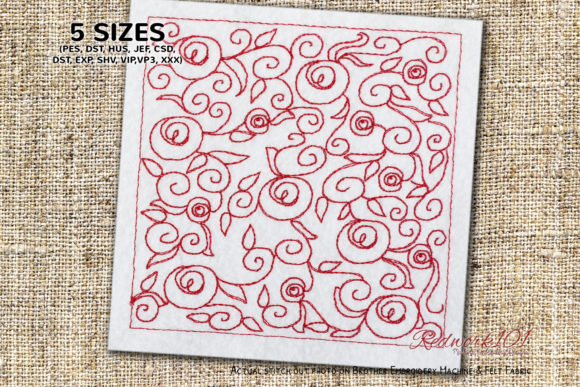
When I opened the Abstract Rose Pattern on Creative Fabrica, I wasn’t met with a literal rose — and that’s exactly why it stood out. This isn’t botanical realism; it’s lyrical movement. Swirling paisley-inspired curves interlace with open negative space, soft gradients of line weight, and rhythmic repetition that feels intentional, not algorithmic. The “box stitch” shown in the preview is optional — a smart touch — meaning you can choose clean framing or let the motif breathe organically. Visually, it lands somewhere between modern textile art and heirloom embroidery: delicate enough for baby blankets, bold enough for tote bags, and versatile enough to anchor a seasonal Etsy collection.
Fits Real Projects — Not Just Pretty Previews
I tested Abstract Rose Pattern across six real production scenarios: a linen kitchen towel, a cotton blend sweatshirt, a curved cap front, a 6” hoop pillow cover, a cotton baby blanket, and a twill apron. It performed consistently well — especially where many abstract designs falter. The fill stitch areas aren’t overly dense, so they lie flat on medium-weight fabrics without puckering. Running stitch accents add dimension without trapping lint or snagging during wear. On stretchy sweatshirt fabric, I used a light cutaway stabilizer and saw no distortion — a win for custom apparel makers who avoid re-hooping mid-run.
The motif scales beautifully. At 3.5”, it reads clearly on a cap without losing its fluidity. At 5.2”, it becomes a statement on a tote bag design — elegant but not fussy. For nursery decor or personalized gifts, I stitched it on a 100% cotton baby blanket using pastel thread colors; the satin stitch petals held crisp definition even after two gentle machine washes. That durability matters — especially when selling handmade products customers will treasure and launder.
What Works — And Where to Pause
Works well for:
- Tote bag design — Clean lines prevent fraying at seams; works with both canvas and lightweight denim
- Sweatshirt embroidery — Balanced stitch density avoids stiffness around shoulders and sleeves
- Embroidered patch — The outer box option makes clean edge cutting easy; ideal for iron-on or sew-on patches
- Pillow cover & apron — Flows naturally over curved surfaces without warping
- Printable mockup — Its balanced composition photographs cleanly on lifestyle shots and digital listings
Use with care on:
- Dark fabric — Some inner details rely on subtle tonal shifts; test thread color contrast before bulk runs
- Tiny hoops (under 4”) — While scalable, the smallest recommended size maintains clarity — check file details before resizing down
- Layered details — Though not an applique design, overlapping curves benefit from proper underlay stitching to prevent shadowing on textured weaves
Impact Beyond the Hoop: Brand, Trust, and Buyer Connection
As a designer who sells embroidery files and finished goods, I pay close attention to how a pattern affects perceived value. Abstract Rose Pattern elevates handmade presentation without shouting. It doesn’t scream “trendy” — it whispers “thoughtfully made.” That subtlety builds buyer trust, especially for Etsy sellers and boutique merchandise. Customers notice craftsmanship in the smooth satin stitch transitions and intentional spacing — cues that signal care, not automation.
For personalized gifts and custom apparel, this design supports brand consistency. Its neutral-yet-artistic voice pairs easily with monogrammed initials or minimalist text. I used it alongside a simple “June” script on a linen baby blanket — the combo felt cohesive, not cluttered. In product photography, its balanced negative space lets backgrounds shine, making flat-lays and lifestyle shots more engaging. That directly supports customer engagement — fewer scrolled-past listings, more saved pins and wishlisted items.
Practical Notes Every Embroiderer Should Check
Before adding Abstract Rose Pattern to your next order or digital embroidery file library, do these five things:
- Test on scrap fabric — Especially if using textured, dark, or stretchy substrates
- Review stitch density — Lighter fills mean less stabilizer needed, but confirm density aligns with your machine’s tension profile
- Confirm hoop size compatibility — The design’s flow benefits from stable hooping; verify minimum hoop requirements listed on the Creative Fabrica product page
- Compare light/dark fabric mockups — Thread color choice changes how the paisley rhythm reads; soft contrasts enhance abstraction, high contrast emphasizes structure
- Inspect small details post-stitch — Tiny loops and tapered ends should be clean; if they’re frayed or skipped, revisit needle type and stabilizer pairing
Also: Always review licensing terms on the Creative Fabrica product page before using Abstract Rose Pattern in commercial embroidery or as part of a finished product you sell. Licensing varies by seller — some allow unlimited physical use, others restrict digital resale. When in doubt, reach out to the designer directly through Creative Fabrica.
Final Thought: A Quietly Versatile Workhorse
Abstract Rose Pattern won’t dominate your catalog — and that’s its strength. It’s the kind of embroidery file you return to again and again: for bridal shower towels, gender-neutral baby gifts, boutique aprons, or limited-run caps. It bridges fine craft and everyday function. It respects fabric. It rewards attention to detail. And for creative entrepreneurs building a recognizable, trustworthy handmade brand? That quiet consistency — across products, seasons, and customers — is worth more than flash.